Hello Nashville Vision Therapy Fans! I hope you are staying warm where ever you are. I just wanted to let you know our blog has moved. We have a new website, and have been doing our blogs there for the last couple of months. It is better to have everything in one place. The blogs you have missed are:
http://opmt.com/handwriting-and-vision-problems/
http://opmt.com/strabismus/
All the blogs will stay on blogger for you, just wanted to let you know we have moved to here:
http://opmt.com/category/vision-therapy-blog/
See you there!
OPMT VT Team

Thursday, February 19, 2015

Thursday, September 18, 2014
We are on Pinterest!

Our Pinterest Page is fairly new so we are still busy adding
helpful pins to our boards for you to explore! So if you have a Pinterest Page
be sure to follow us so you can stay connected with the Vision Therapy world!
Here is the link to our Pinterest Page: www.pinterest.com/opmt
Tuesday, September 2, 2014
3 Myths about Vision Therapy
Myth: If you have 20/20 eyesight, you have perfect vision.
Fact: When your child does a school screening and passes
with visual acuities of 20/20, it does NOT mean they have good vision. The
visual acuities have nothing to with how well the eyes function together and
how they interpret or process what they see. The eye chart does not measure
peripheral vision, depth perception, color perception or eye-hand coordination
which is all part of vision. Eyesight and vision are different.
Myth: Vision Therapy is for kids.
Fact: No, vision therapy is for children and adults. Vision
therapy is actually more effective for adults because they are usually highly
motivated to improve their visual abilities. For adults, it is common to have
visual problems with activities up close like reading, using the computer, or
writing. If an adult performs these
activities daily and their eyes do not work well together for long periods of
time, then it is not uncommon for them to experience eye strain or eye
fatigue.
Myth: If a child has a short attention span and behavior
problems, then they most likely have ADD/ADHD.
Fact: Sometimes when a child exhibits behavior such as
impulsivity, hyperactivity and distractibility they are diagnosed with ADD/ADHD,
but they might actually only have a learning difficulty because their eyes
might not be working together and it is hard for them to focus and learn. A
child might have a short attention span due to the fact they have a hard time
focusing on their work because of a vision problem. According to the website
covd.org, “A recent study by researchers at the
Children's Eye Center,
University of San Diego, uncovered a relationship
between a common vision disorder, convergence insufficiency, and ADHD. The study
"showed that children with convergence insufficiency are three times as
likely to be diagnosed with ADHD than children without the disorder."
Before an ADD/ADHD diagnosis is made, please consider getting your child a
comprehensive eye exam.
What other myths have you heard about Vision Therapy? Let us know and we will give you some more facts.
Monday, August 11, 2014
It is Vision and Learning Month!
August is Vision and Learning Month! Since our children are
starting to head back to school, it is important to educate parents and teachers about the link between vision and learning. Some children may
struggle with reading or learning and it could be associated with vision
problems, but that is often overlooked.
When a parent says, “My child has 20/20 vision, he can not have
a vision problem.” That is not true. The
vision screenings that are done at school do not always test for eye
coordination and eye movement disorders. With that being said, vision problems
are often overlooked because these possible problems could be mistaken for
behavior or attention problems.
If a child has a vision problem that goes undetected he or she may struggle with reading and doing their school work. Some signs that the child may be struggling
could be fidgeting, fatigue, headaches, and frustrations in the classroom.
As mentioned above, it is not about
just having 20/20 vision. Many other factors go into vision and learning. Please be aware of this if you notice your
child struggling to read and learn. Early diagnosis and treatment is beneficial to help our children succeed. When scheduling your child's back-to-school
eye exam choose a doctor that is a developmental
optometrist.
More on blogs that we have done in relation to Vision & Learning here:
Is there correlation between ADD/ADHD and vision problems?
How are Vision and Learning linked?
'My child gets vision screenings at school, isn't that good enough?'
Teacher Resources
Learning Disabilities Awareness Month
Thursday, July 3, 2014
Tim Howard- How does he do it?
 Tim Howard: goalie for the U.S. Men’s World Cup Soccer Team.
In this week's game, he made the most recorded saves in a World Cup Match.
Tim Howard: goalie for the U.S. Men’s World Cup Soccer Team.
In this week's game, he made the most recorded saves in a World Cup Match.How does he do this? In order for someone like a goalie to block a ball from going into the net, the goalie’s eyes need to work together to converge and focus on one object (the ball). Having our eyes work together to see a single image is very important especially for learning and everyday life. You use your eyes everyday to read, throw/hit a ball or look at an object nearby.
If you notice that your child has trouble focusing their
eyes, there are simple everyday activities that you and your child could do to
improve eye focus and it doesn’t even feel like work! Tossing an object at a
target is one of the best training procedures for developing hand/eye
coordination and the ability to locate objects in space.
·
Roll a ball back and forth.
·
Throw a ball or bean bags back and forth.
·
Throw a ball into a target like a bucket.
Notice that all these activities are hands on and do not
involve technology. It is important to
play with actual toys in real space to improve your eye teaming ability. This is essential for the development in a
young child. Who knows, maybe one day your child will end up playing goalie for
the U.S. Men’s Soccer Team making more saves than Tim Howard.
Tuesday, May 6, 2014
Double Vision in Children
In
today's blog we are going to talk about double vision. The most common cause of
double vision is that the eyes are misaligned, which then causes two different
images to be sent to the brain. Typically, the images are either side by side or
overlapping.
When
I have a student comes into our office for an assessment, one of my first
questions is, "do you ever see two of whatever you are looking at?" And when
they say "yes", it is almost like they are wondering, "How on earth did this
lady know?"
When
I am sitting in the room with just the parents discussing the assessment results
and I tell them “your child has double vision,” often those parents feel
terrible or guilty for not knowing. I have had parents in my office with tears
in their eyes saying, "you must think I am the worst
mother."
Of
course, these parents aren’t awful at all! Let's break it down; a child is not
aware that what they are seeing is abnormal. Therefore, they are unable to
communicate their double vision to their parents--children think everyone sees
the world as they do. It is not uncommon for parents to be unaware of their
child's double vision.
If
you suspect your child may have double vision, here are some signs to look out
for:
- Reading problems
- Skipping or repeating words
- Overlapping letters when writing
- Lots of headaches
- Poor depth perception
The
good news is, we can treat double vision through vision therapy and/or prism
lenses. Since the problem is that the eyes are misaligned we can help alleviate
the issue by getting to work on eye teaming exercises.
While
hearing your child having double vision is alarming, there are
solutions!
Wednesday, March 5, 2014
March is Brain Injury Awareness Month
In honor of Brain Injury Awareness Month here are all the blogs we have posted about this subject:
Concussions
Concussions Continued
Neuro-Optometric Rehabilitation
Here are two of our success stories:
My name is Adam. In 1994, when I was three years old I was diagnosed with a brain tumor. That same year I had my initial surgery, where the doctors were able to remove about 60% of the tumor. A month before the surgery a shunt was put in due to hydrocephalus (fluid buildup inside the skull) and spinal tap was performed to assess the tumor. Eight months after the first surgery, the tumor grew back twice the original size. The doctors were able to remove about 90% of the tumor at the time, the remaining 10% of the tumor had latched onto my brain.
As long as I can remember my left eye had given me trouble. It would veer out and would get worse when I was tired. This caused me to have double vision all the time.
With the double vision, I would get tired easily because of the difficulties with trying to concentrate. I even got surgery on my left eye to try to correct the double vision, but unfortunately my double vision got worse as time went on.
This past year I was enrolled in the Traumatic Brain Injury program at Tennessee Rehabilitation Center. They referred me to Optometric Physicians of Middle Tennessee. I saw Dr. Durocher; he ran a series of tests to see what he could do to help my eyes work together. He fitted me for glasses with prisms and gave me home Vision Therapy exercises. This made my double vision go away!
Since the double vision went away I am now able to work. I am currently employed at TJ Maxx in Brentwood and I am doing very well at work. I will continue to see Dr. Durocher and his team whenever I need help with my eyes. The staff treated me so well at Dr. Durocher's office. I had a wonderful time working with Dr. Durocher. I am very thankful to Dr. Durocher and his staff for helping me. They cured one of my biggest problems, and are a great group of people.
---------------------------------------------------------------
My name is Esmeralda. I was diagnosed with trigeminal neuralgia. To treat it I had a surgery called Microvascular Decompression (MVD). It is a surgical procedure that relieves abnormal compression of a cranial nerve. There was a complication with my surgery and I had a brain hemorrhage. After the brain hemorrhage I lost mobility in my right eye, had blurred vision in both eyes, and double vision.
I then started rehab and then they referred me to Dr. Durocher. He examined my eyes, he then prescribed me prism lenses and recommended I do aggressive Neuro-Optometric therapy. I started therapy with Mrs. Kate, she gave me home therapy and I started to see her weekly. She began to work hard on my eyes. After a few weeks I started using my eyes together, and didn’t see any double vision! I thank God and the help of the medical staff at Optometric Physicians. I believe that therapy is critical to recovery, and I want to thank them for all the help with my eyes. May God bless you and give you wisdom to continue to help, to those who need it most.
------------------------------------------------------------------
It has been an honor to have had the pleasure to work with Adam and Esmeralda. It motivates me to continue to help spread the word about Vision Therapy and Neuro-Optometric Rehabilitation. If you know someone who has had a Brain Injury refer them to your local optometrist.
Concussions
Concussions Continued
Neuro-Optometric Rehabilitation
Here are two of our success stories:
My name is Adam. In 1994, when I was three years old I was diagnosed with a brain tumor. That same year I had my initial surgery, where the doctors were able to remove about 60% of the tumor. A month before the surgery a shunt was put in due to hydrocephalus (fluid buildup inside the skull) and spinal tap was performed to assess the tumor. Eight months after the first surgery, the tumor grew back twice the original size. The doctors were able to remove about 90% of the tumor at the time, the remaining 10% of the tumor had latched onto my brain.
As long as I can remember my left eye had given me trouble. It would veer out and would get worse when I was tired. This caused me to have double vision all the time.
With the double vision, I would get tired easily because of the difficulties with trying to concentrate. I even got surgery on my left eye to try to correct the double vision, but unfortunately my double vision got worse as time went on.
This past year I was enrolled in the Traumatic Brain Injury program at Tennessee Rehabilitation Center. They referred me to Optometric Physicians of Middle Tennessee. I saw Dr. Durocher; he ran a series of tests to see what he could do to help my eyes work together. He fitted me for glasses with prisms and gave me home Vision Therapy exercises. This made my double vision go away!
Since the double vision went away I am now able to work. I am currently employed at TJ Maxx in Brentwood and I am doing very well at work. I will continue to see Dr. Durocher and his team whenever I need help with my eyes. The staff treated me so well at Dr. Durocher's office. I had a wonderful time working with Dr. Durocher. I am very thankful to Dr. Durocher and his staff for helping me. They cured one of my biggest problems, and are a great group of people.
---------------------------------------------------------------
My name is Esmeralda. I was diagnosed with trigeminal neuralgia. To treat it I had a surgery called Microvascular Decompression (MVD). It is a surgical procedure that relieves abnormal compression of a cranial nerve. There was a complication with my surgery and I had a brain hemorrhage. After the brain hemorrhage I lost mobility in my right eye, had blurred vision in both eyes, and double vision.
I then started rehab and then they referred me to Dr. Durocher. He examined my eyes, he then prescribed me prism lenses and recommended I do aggressive Neuro-Optometric therapy. I started therapy with Mrs. Kate, she gave me home therapy and I started to see her weekly. She began to work hard on my eyes. After a few weeks I started using my eyes together, and didn’t see any double vision! I thank God and the help of the medical staff at Optometric Physicians. I believe that therapy is critical to recovery, and I want to thank them for all the help with my eyes. May God bless you and give you wisdom to continue to help, to those who need it most.
------------------------------------------------------------------
It has been an honor to have had the pleasure to work with Adam and Esmeralda. It motivates me to continue to help spread the word about Vision Therapy and Neuro-Optometric Rehabilitation. If you know someone who has had a Brain Injury refer them to your local optometrist.
Monday, February 3, 2014
Home Therapy Tips
 In my last blog post, I referenced the most popular blogs. All were connected on how to make therapy more fun. They are popular because doing therapy the recommended 6 times a week can be challenging and by making it more fun it becomes easier.
I have stated the importance of therapy in a blog post titled "Home Therapy". "Your visual system is working 24 hours a day, 7 days a week. With vision therapy we are looking to change the behavior of your visual system and to do that it is all about repetition. That is the key to being successful. Our goal is to make the visual system automated (which means working on it's own without you having to think about it), and the best way to do that is through repetition."
Recently, I read this blog and I want everyone of my parents to read it: Tips for Scheduling Your Child's At-Home Vision Therapy Activities.
What are your thoughts? How can you make Vision Therapy priority?
Tuesday, January 28, 2014
Happy 2014
 |
| Duke is happy it is the New Year too! |
I would like to start the first blog of the New Year by taking the time and share the top 5 most popular blog posts in 2013.
1. Workin' the Vestibular System
2. Wii Fit
3. Family Game Night
4. Work That Peripheral Vision
5. Treatment Tools
I really enjoyed those blogs, they were very interactive. I'm looking forward to doing more blogs like that this year.
All these blogs have one main thing in common: they involve a lot of hands on activities. If you know me, I am all about hands-on activities! We are becoming a generation where our children's "hands-on" activities are on an iPad.
When children are very young, their visual systems are still developing. Developing children need to interact with objects in real space. It’s how they develop depth perception, eye teaming, tracking and other visual skills.
I am going to say it again- developing children need to interact with objects in real space! Not on a flat screen. Here is an article I found this past December, have been wanting to share. The article is called, "Generation of iPad children who cannot hold a pencil:Playing with touch-screen devices means youngsters are struggling to learn basic motor skills."
Thursday, December 19, 2013
Concussion Continued
If you have ever experienced a concussion, there are a number of symptoms that relate to the connection between vision function and concussions. These symptoms can include:
"For the student athlete, these symptoms can have a huge effect on learning and school performance. These vision problems can also linger months after the initial pain and headaches associated with the concussion have gone away. The most common causes of these problems are a convergence insufficiency (eyes that don’t work well together at near) and/or accommodative (focusing) insufficiency following the injury.
The good news is that these vision problems respond well to optometric intervention. Treatment usually consists of a combination of glasses for reading and optometric vision therapy. These treatments allow the student to return to their academic activities much sooner than just waiting for things to clear up on their own."
I also wanted to touch base on a test that can be performed on the sidelines of sports events to make return-to-game decisions. We have heard or seen athletes go back into a game after experiencing a concussion. Long- and short-term effects can be very dangerous.
After a concussion the ability to perform saccadic eye movements (changing gaze) will be impaired. "Saccadic eye movements are very complex and require coordination across a wide network of anatomical structures in the brain. Concussions have immediate impact on the brain’s networking skills. The result is decreased performance on tests of saccadic eye movements, especially subjective procedures that require a verbal response from the athlete.
The King-Devick Test has been used to evaluate the eye movement skills of children, especially those with learning and reading problems. Now, it can be used on the sidelines of sports events to make return-to-game decisions! A decrease in performance from a baseline measurement is a very strong indicator that the athlete has suffered a concussion and should not be allowed to return to the playing field until evaluated by a neurologist."
The King-Devick might look very familiar to most of you that have had your child perform the Perceptual Motor Evaluation here at our office. Take a look at this video:
Please spread the word about the King-Devick Test. It can make a huge difference in a lot of athletes lives. If you or someone you know has recently had a concussion go to your local optometrist and neurologist.
Some of the information was taken from COVD blogs here:
There's More to Concussions than Meets the Eye
Eye Protect Brain
- –blurred vision – especially when reading
- –headaches associated with reading
- –double vision
- –eye pain
- –poor reading comprehension
- –light sensitivity
- –frequent loss of place when reading
"For the student athlete, these symptoms can have a huge effect on learning and school performance. These vision problems can also linger months after the initial pain and headaches associated with the concussion have gone away. The most common causes of these problems are a convergence insufficiency (eyes that don’t work well together at near) and/or accommodative (focusing) insufficiency following the injury.
The good news is that these vision problems respond well to optometric intervention. Treatment usually consists of a combination of glasses for reading and optometric vision therapy. These treatments allow the student to return to their academic activities much sooner than just waiting for things to clear up on their own."
I also wanted to touch base on a test that can be performed on the sidelines of sports events to make return-to-game decisions. We have heard or seen athletes go back into a game after experiencing a concussion. Long- and short-term effects can be very dangerous.
After a concussion the ability to perform saccadic eye movements (changing gaze) will be impaired. "Saccadic eye movements are very complex and require coordination across a wide network of anatomical structures in the brain. Concussions have immediate impact on the brain’s networking skills. The result is decreased performance on tests of saccadic eye movements, especially subjective procedures that require a verbal response from the athlete.
The King-Devick Test has been used to evaluate the eye movement skills of children, especially those with learning and reading problems. Now, it can be used on the sidelines of sports events to make return-to-game decisions! A decrease in performance from a baseline measurement is a very strong indicator that the athlete has suffered a concussion and should not be allowed to return to the playing field until evaluated by a neurologist."
The King-Devick might look very familiar to most of you that have had your child perform the Perceptual Motor Evaluation here at our office. Take a look at this video:
Please spread the word about the King-Devick Test. It can make a huge difference in a lot of athletes lives. If you or someone you know has recently had a concussion go to your local optometrist and neurologist.
Some of the information was taken from COVD blogs here:
There's More to Concussions than Meets the Eye
Eye Protect Brain
Monday, November 11, 2013
Concussion
Last week, I blogged about Traumatic Brain Injury. Today, I want to focus on concussions. This is such a hot topic these days. A month ago, PBS Frontline did an investigative piece called, "League of Denial: The NFL's Concussion Crisis." If you haven't seen it, watch the full story here.
Leading up to that there were numerous articles about concussions:
Wall Street Journal
USA Today
New York Times
Time Magazine
National Geographic
There are a number of symptoms that relate to the connection between vision function and concussions. These symptoms can include:
So once a concussed person experiences these symptoms, then what? I will discuss that in our next blog. I will also discuss a screening test that provides an effective way to detect early signs of concussion. Stay tuned!
Leading up to that there were numerous articles about concussions:
Wall Street Journal
USA Today
New York Times
Time Magazine
National Geographic
There are a number of symptoms that relate to the connection between vision function and concussions. These symptoms can include:
- –blurred vision – especially when reading
- –headaches associated with reading
- –double vision
- –eye pain
- –poor reading comprehension
- –light sensitivity
- –frequent loss of place when reading
Tuesday, October 29, 2013
Neuro-Optometric Rehabilitation
Today we are going to talk about neuro-optometric rehabilitation. This is an individualized treatment regime for patients with visual deficits as a direct result of a brain injury.
Brain injuries can come in many forms:
- Traumatic Brain Injury (TBI)
- Mild Acquired Brain Injury
- Mild Closed Head Injury
- Post-Concussive Syndrome
- Cervical Trauma Syndrome
- Post Traumatic Vision Syndrome
- Stroke
- Cerebral Palsy
- Cerebral Vascular Accident
The following is a list of symptoms of visual problems which can result from brain injuries:
- Sensitivity to light, glare sensitivity
- Blurred Vision
- Reading difficulties; words appear to move
- Comprehension difficulty
- Attention and concentration difficulty
- Memory difficulty
- Double vision
- Aching eyes
- Headaches with visual tasks
- Inability to maintain visual contact
- Reduction or loss of visual field
-
Difficulties with eye movements, such as:
- Ocular pursuits (eye tracking ability)
- Saccadics (shifting gaze quickly from one point to the other)
- Accommodative inability (focusing)
- Binocular vision (eye alignment, eye teaming)
- Visual field loss
These visual problems can be successfully decreased or eliminated with neuro-optometric rehabilitation. The goal of the therapy is to train healthy parts of the brain to perform the work of the damaged part of the brain. Corrective lenses (such as prism lenses) is another treatment to decrease/ eliminate visual problems.
Here at Optometric Physicians, we want to be able to help our patients regain control and independence in everyday living situations. Those affected by a TBI should first schedule a comprehensive eye exam. Click on this link for some of our success stories.
Friday, October 18, 2013
Home Therapy
Being part of a vision therapy program is a lot of hard work. I will be the
first to admit it. Our program consists of approximately 30 minutes of
one-on-one in-office therapy, one to two times a week. On top of that, we
recommend 20-30 minutes of home therapy six times per week.
Getting my patients to do the therapy at home is such a BIG part of their success. Why is it so important?
Simply said, your visual system is working 24 hours a day, 7 days a week. With vision therapy we are looking to change the behavior of your visual system and to do that it is all about repetition. That is the key to being successful. Our goal is to make the visual system automated (which means working on it's own without you having to think about it), and the best way to do that is through repetition.
Doing vision therapy at home can be tough, especially when you have to do it six times per week. But as your child learns the skill they're working on, starts to ingrain the skill, and finally begins integrating that skill into a fully functioning visual system, that makes all the hard work SO worth it.
Seeing your vision therapist one or two times a week for in-office therapy is not enough. You will see better and faster results when therapy is also done at home six times a week for 20-30 minutes. Then you can be another success story!
To close, it takes a team. I will do my part, but we need your help too. Parents, together let's help your child!
I have also written many blogs about different ways to make therapy fun:
Getting my patients to do the therapy at home is such a BIG part of their success. Why is it so important?
Simply said, your visual system is working 24 hours a day, 7 days a week. With vision therapy we are looking to change the behavior of your visual system and to do that it is all about repetition. That is the key to being successful. Our goal is to make the visual system automated (which means working on it's own without you having to think about it), and the best way to do that is through repetition.
Doing vision therapy at home can be tough, especially when you have to do it six times per week. But as your child learns the skill they're working on, starts to ingrain the skill, and finally begins integrating that skill into a fully functioning visual system, that makes all the hard work SO worth it.
Seeing your vision therapist one or two times a week for in-office therapy is not enough. You will see better and faster results when therapy is also done at home six times a week for 20-30 minutes. Then you can be another success story!
To close, it takes a team. I will do my part, but we need your help too. Parents, together let's help your child!
I have also written many blogs about different ways to make therapy fun:
How to Make Vision Therapy Home Exercises Fun!
Fun Home Exercises! Continued....
Travel Therapy
Family Game Night!
Workin' the Vestibular System
Work that Peripheral Vision
Vision Therapy Masking Tape Games
Thursday, October 3, 2013
Learning Disabilities Awareness Month

Vision Problems Mistaken for Learning Disabilities: College of Optometrists in Vision Development Observes Learning Disabilities Awareness Month
More articles that I have blogged about that are related to Vision and Learning:
- How are Vision and Learning linked?
- Does your child have bad handwriting?
- My child gets vision screenings at school isn't that good enough?
- Teacher Resources
Nashville Vision Therapy
4322 Harding Pike, Suite 214
Nashville, TN 37203
ph. (615) 386-3086
Wednesday, September 25, 2013
It's a Brain Thing
Coming back from the seminar, I was filled with more knowledge and therapy procedures. I was excited to show my patients some new fun exercises. Today I am going to share some of my notes I wrote down:
- Eye turn is not the problem- only a symptom.
- Eye turn is not an eye muscle problem- hence why surgery to correct an eye turn is just a cosmetic treatment.
- Not an eye muscle problem- it is a brain thing
- 3-6 mounts of age is when eye teaming develops
- Eye turn is a binocular vision problem
- Goal in vision therapy is to make the patient a two eyed person
- 83% of the acuity goes back with just passive patching. Passive patching: just putting a patch over "strong eye" to use "weaker eye" for a number of hours without any stimulation.
- Does your child have a constant head tilt? Head tilt to the left means your right eye is dominant. Head tilt to the right means you are left eye dominant.
- Head tilt compensates for what going on. It helps suppress other eye.
- The eyes don't tell us what to see. The brain tells your eyes what to look for.
- Sue Barry- does Brock String exercise 5-10 minutes a day. Still!
- With Vision Therapy we try to develop a new neuro-pathway.
- If the visual system is not your child's dominant sense then they touch everything or are easily distracted. Who can relate with this?
- Call the "good/strong eye" the "teaching eye" and the "bad/weaker eye" the "learning eye".
Thursday, September 12, 2013
I'm ready to learn!
This weekend I am heading to Detroit for an Advance Vision Therapy Seminar. I will be learning more about Strabismus and Amblyopia. I am hoping to bring back more new VT tools and ideas to help my patients.
Let's talk about what Strabismus! Straight from the COVD website:
Strabismus or crossed eyes, is the inability to point both eyes in the same direction at the same time. One eye may appear to turn in (esotropia), out (exotropia), up (hypertropia), or down (hypotropia). The eye turn may occur constantly or only intermittently. Eye-turning may change from one eye to the other, and may only appear when a person is tired or has done a lot of reading. Strabismus may cause double vision. To avoid seeing double, vision in one eye may be ignored resulting in a lazy eye (amblyopia).
Crossed eyes most often develop in infants and young children, although it can occur in adults. This may also be caused by:
To repeat, "to avoid seeing double, vision in one eye may be ignored resulting in a lazy eye (amblyopia)." What does that crazy looking word mean?
When the clarity or alignment of the images from the two eyes is very different, or if the child sees double, the brain may begin to ignore the vision in one eye. This can result in amblyopia. The favored eye compensates for the "lazy eye," so the child with amblyopia may not be aware of the problem until the better eye is covered.
Strabismus and Amblyopia are easily confused. But as you can see, there is a BIG difference between the two. I am excited to build more confidence and learn more fun exercises this weekend. Keep you posted! Have a great weekend, and I hope you do some learning this weekend too.
Let's talk about what Strabismus! Straight from the COVD website:
Strabismus or crossed eyes, is the inability to point both eyes in the same direction at the same time. One eye may appear to turn in (esotropia), out (exotropia), up (hypertropia), or down (hypotropia). The eye turn may occur constantly or only intermittently. Eye-turning may change from one eye to the other, and may only appear when a person is tired or has done a lot of reading. Strabismus may cause double vision. To avoid seeing double, vision in one eye may be ignored resulting in a lazy eye (amblyopia).
Crossed eyes most often develop in infants and young children, although it can occur in adults. This may also be caused by:
- Inadequate development of eye coordination in childhood
- Excessive farsightedness or differences between the vision in each eye
- Problems with the eye muscles that control eye movement
- Head trauma, stroke, or other general health problems
To repeat, "to avoid seeing double, vision in one eye may be ignored resulting in a lazy eye (amblyopia)." What does that crazy looking word mean?
When the clarity or alignment of the images from the two eyes is very different, or if the child sees double, the brain may begin to ignore the vision in one eye. This can result in amblyopia. The favored eye compensates for the "lazy eye," so the child with amblyopia may not be aware of the problem until the better eye is covered.
Strabismus and Amblyopia are easily confused. But as you can see, there is a BIG difference between the two. I am excited to build more confidence and learn more fun exercises this weekend. Keep you posted! Have a great weekend, and I hope you do some learning this weekend too.
Thursday, September 5, 2013
Vision Therapy Masking Tape Games
Happy September! Hope everyone had a great Labor Day weekend!
When you walk into our therapy room, you will always notice all the tape on the carpet. Here's another fun Vision Therapy game, with a little help from masking tape. It's easy, cheap, and effective!
Whose child is still reversing their b, d, p, q's? Here is a fun thing you can do:

Have your child stand in the middle and call out the letter you want them to hop to! FUN!
If you remember I blogged about balance and I used masking tape for the balance beam. Check it out here: Workin' the Vestibular System
For more ideas, visit What to Expect with a blog post titled "Indoor Family Activities- Just Add Masking Tape." These games work on a perceptual skills, balance, peripheral vision, and eye-hand coordination. That sounds like fun Vision Therapy to me!
Try these games out! I promise it will bring you lots of fun and it's easy clean up! Enjoy!
When you walk into our therapy room, you will always notice all the tape on the carpet. Here's another fun Vision Therapy game, with a little help from masking tape. It's easy, cheap, and effective!
Whose child is still reversing their b, d, p, q's? Here is a fun thing you can do:

Have your child stand in the middle and call out the letter you want them to hop to! FUN!
If you remember I blogged about balance and I used masking tape for the balance beam. Check it out here: Workin' the Vestibular System
For more ideas, visit What to Expect with a blog post titled "Indoor Family Activities- Just Add Masking Tape." These games work on a perceptual skills, balance, peripheral vision, and eye-hand coordination. That sounds like fun Vision Therapy to me!
Try these games out! I promise it will bring you lots of fun and it's easy clean up! Enjoy!
Wednesday, August 28, 2013
New School Year is Not the Only Thing New Around Here

I don't know about you, but this year is flying by. A month has passed since Duke has graced this blog!
What have we been up too? A new doctor - Dr. Dale Martin - has joined our team, we opened a new office in Hendersonville, and a lot more. Busy busy busy!
Yes! You heard me, we have a new office in Hendersonville! Though that office isn't offering vision therapy, we provide: Comprehensive Eye Exams, Contact Lenses, Advanced Dry Eye Treatment, and Pediatric Vision Care.
School is also back in session. With the new school year started that means new teachers. Do they know your child is/was in a Vision Therapy program? Do they know about classroom accommodations? Email me, if you need help with communicating with teachers: VT@rdeyes.com.
Keep me posted if you need any assistance with therapy at home and communication with teachers.
Friday, July 26, 2013
Treatment Tools
 Meet Duke, an American Pit Bull Terrier. He is going to help us model each treatment lens we use here at Nashville Vision Therapy. Thanks, Duke!
To start us off, Duke is demonstrating his focusing abilities and anticipating a tracking exercises. He gets a little bored of just focusing and following a eyeball, so he decided to show us some fancy treatment tools our office uses during Vision Therapy.
Here we go...

Why is Duke wearing 4 lenses? Great question! These are called accommodative flippers. These lenses are used to improve the flexibility and strength of a patient’s focusing system. We use these with the Hart (letter) Chart, when reading, and when we use a tool called Aperture Rule. There are minus lenses on one side, and plus lenses on the other. The word "flipper" comes in handy because you flip the lenses back and forth while doing certain exercises to improve the focusing system.
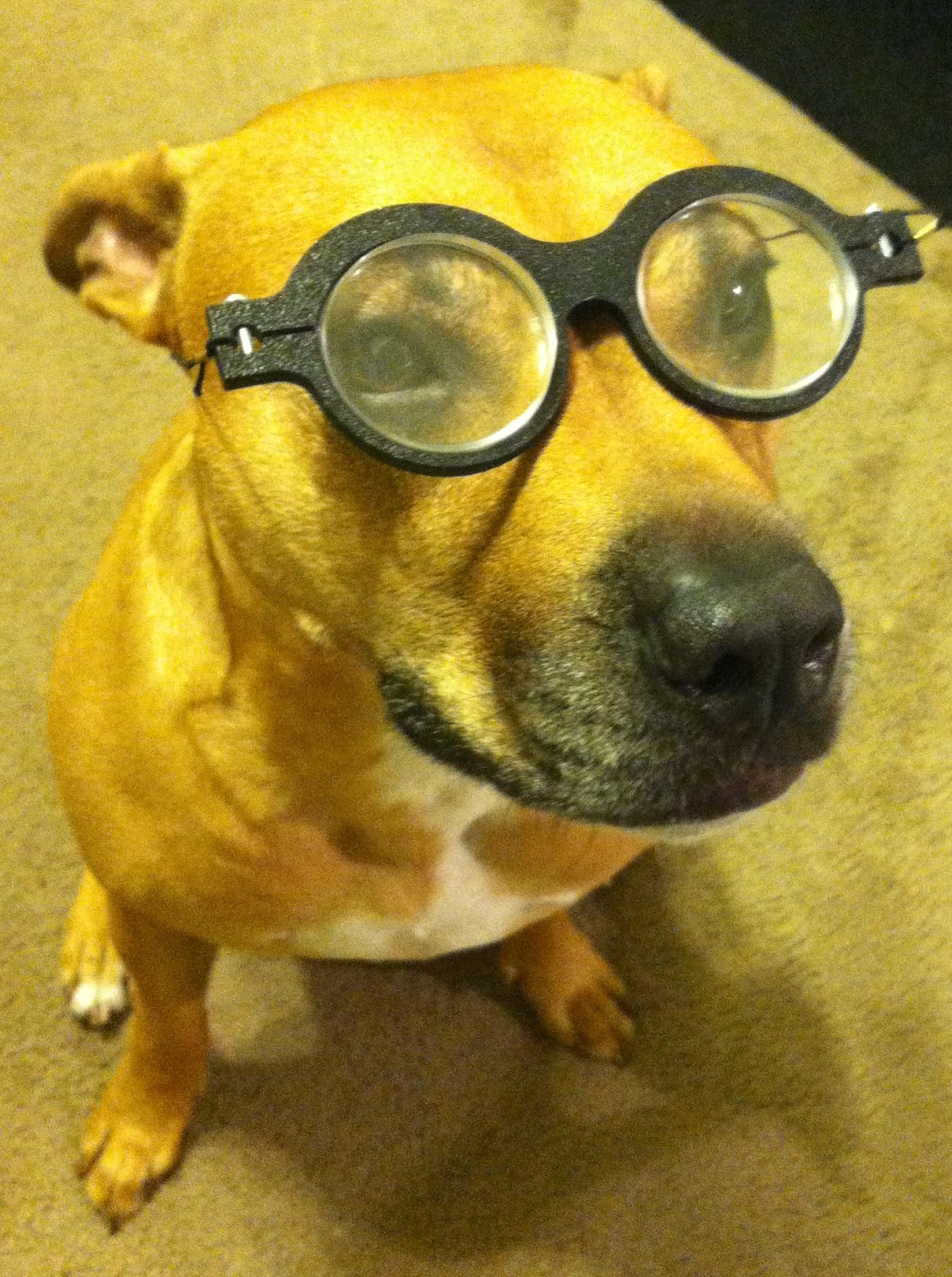

Harry Potter is that you? No, it's just Duke wearing prisms! I could go on and on about prisms. We use them all the time, kids think they are so fun!
"Prisms create total "eye-mind-body” changes and improved perception
of depth and space. Prism produces
changes in orientation with corresponding shifts in both eye movement and
pelvic positions. They are a valuable tool in breaking down patterns that have
developed over time that enable the patient to cope with their visual condition."
Duke circa 1970. These red/green (or can use red/blue lenses) lenses help us use both eyes together. Using these red/green lenses, allows us to see if a patient is suppressing the visual input from one eye.
When using these lenses we use a transparent film with red/ green stripes. We place this film over reading materials, hidden pictures, mazes, or letter charts. When doing the exercises you have to use both eyes enable to see the whole image. If you are not using both eyes, parts of the picture will be missing.
Each one of these tools helps the visual system work more efficiently. What do you think? Which lens have you used during therapy, and with what exercises? Have questions? Email us at VT@rdeyes.com.
Friday, July 19, 2013
Work that Peripheral Vision
Hello, readers. Happy Friday! If you remember, last week we talked about peripheral stability. As promised, here are some fun peripheral awareness exercises for home!
A couple of weeks ago I discussed building up the vestibular system. One of the exercises I mentioned was reading a letter chart while tossing a beanbag from your right to left hand and back again. This exercise is also great for your peripheral vision! Because you’re reading the letter chart, your central vision will be fixed straight ahead. This means that you will have to rely on your peripheral vision to get the beanbag back and forth. You can also use scarves (or a balloon) in place of beanbags to start, since the beanbags fall faster and will be more difficult.
Thanks to a fellow vision therapist, I have been doing a lot peripheral taps lately! They are a great easy home exercise. They note:
Another awesome activity (that works on tracking AND peripheral vision) that I found is described in the following video. This activity would be easy to create at home, and is fun and engaging! Using regular flashlight is just fine.
As Dr. Julie mentioned when children or adults block out peripheral vision which then creates a tunnel vision effect it can cause loss of concentration and/or difficulty driving.
These are fun, easy home exercises to do at home that will greatly improve your peripheral vision. Try them out and let us know how it goes!
A couple of weeks ago I discussed building up the vestibular system. One of the exercises I mentioned was reading a letter chart while tossing a beanbag from your right to left hand and back again. This exercise is also great for your peripheral vision! Because you’re reading the letter chart, your central vision will be fixed straight ahead. This means that you will have to rely on your peripheral vision to get the beanbag back and forth. You can also use scarves (or a balloon) in place of beanbags to start, since the beanbags fall faster and will be more difficult.
Thanks to a fellow vision therapist, I have been doing a lot peripheral taps lately! They are a great easy home exercise. They note:
"Peripheral Taps
1. Place your finger tips near your body facing the student
2. Without taking their eyes off of you (I put a stick on my nose for children to focus on), have the student tap your fingers with his/her finger tips.
3. Alternate hands and places around the face.”
1. Place your finger tips near your body facing the student
2. Without taking their eyes off of you (I put a stick on my nose for children to focus on), have the student tap your fingers with his/her finger tips.
3. Alternate hands and places around the face.”
Another awesome activity (that works on tracking AND peripheral vision) that I found is described in the following video. This activity would be easy to create at home, and is fun and engaging! Using regular flashlight is just fine.
As Dr. Julie mentioned when children or adults block out peripheral vision which then creates a tunnel vision effect it can cause loss of concentration and/or difficulty driving.
These are fun, easy home exercises to do at home that will greatly improve your peripheral vision. Try them out and let us know how it goes!
Subscribe to:
Posts (Atom)