Showing posts with label tracking. Show all posts

Tuesday, May 6, 2014

Double Vision in Children

In today's blog we are going to talk about double vision. The most common cause of double vision is that the eyes are misaligned, which then causes two different images to be sent to the brain. Typically, the images are either side by side or overlapping.

When I have a student comes into our office for an assessment, one of my first questions is, "do you ever see two of whatever you are looking at?" And when they say "yes", it is almost like they are wondering, "How on earth did this lady know?"

When I am sitting in the room with just the parents discussing the assessment results and I tell them “your child has double vision,” often those parents feel terrible or guilty for not knowing. I have had parents in my office with tears in their eyes saying, "you must think I am the worst mother."

Of course, these parents aren’t awful at all! Let's break it down; a child is not aware that what they are seeing is abnormal. Therefore, they are unable to communicate their double vision to their parents--children think everyone sees the world as they do. It is not uncommon for parents to be unaware of their child's double vision.

If you suspect your child may have double vision, here are some signs to look out for:
  • Reading problems
  • Skipping or repeating words
  • Overlapping letters when writing 
  • Lots of headaches
  • Poor depth perception
The good news is, we can treat double vision through vision therapy and/or prism lenses. Since the problem is that the eyes are misaligned we can help alleviate the issue by getting to work on eye teaming exercises.

While hearing your child having double vision is alarming, there are solutions!

Friday, July 26, 2013

Treatment Tools

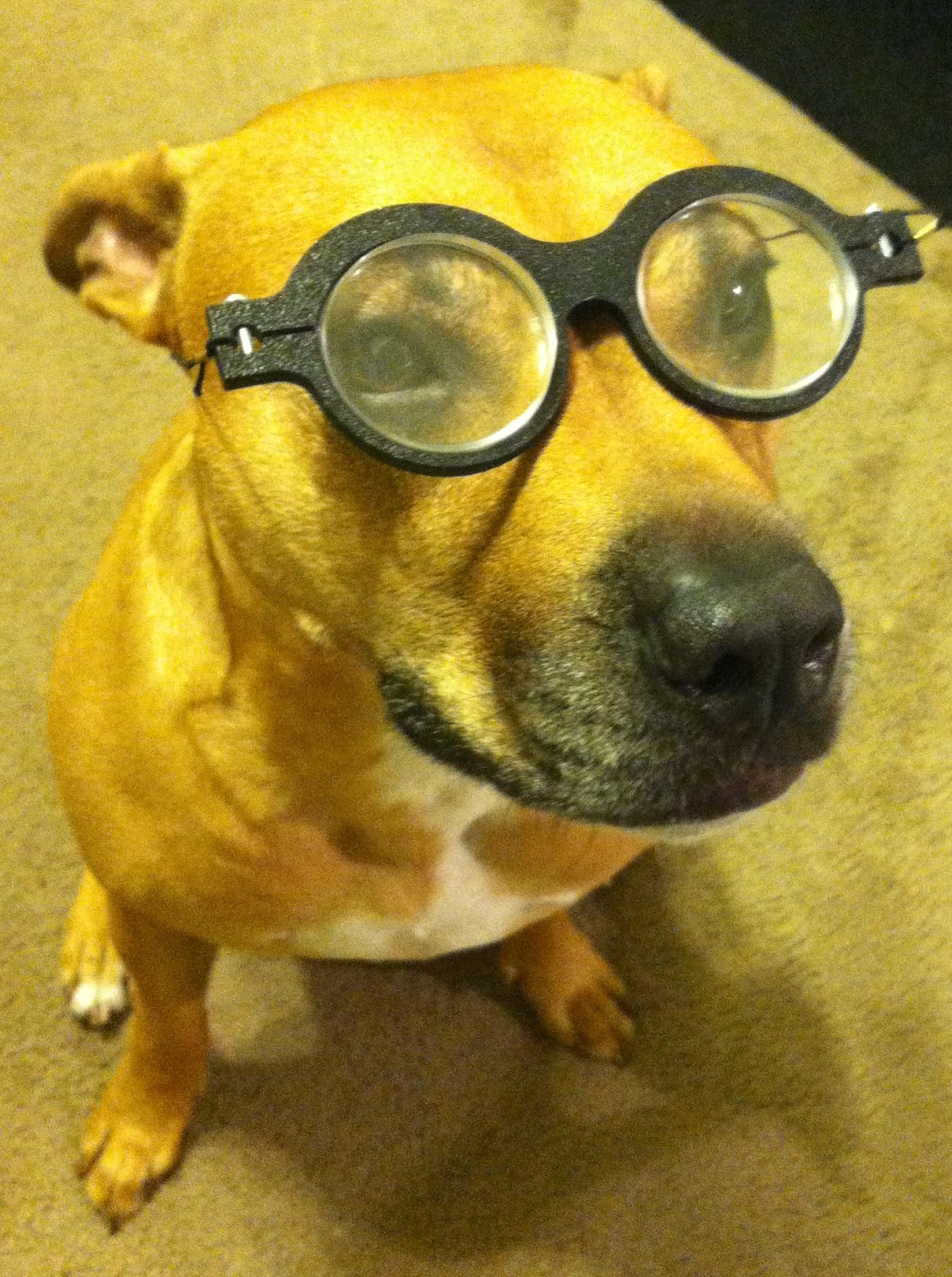
Meet Duke, an American Pit Bull Terrier. He is going to help us model each treatment lens we use here at Nashville Vision Therapy. Thanks, Duke!

To start us off, Duke is demonstrating his focusing abilities and anticipating a tracking exercises. He gets a little bored of just focusing and following a eyeball, so he decided to show us some fancy treatment tools our office uses during Vision Therapy.


Here we go...


Why is Duke wearing 4 lenses? Great question! These are called accommodative flippers. These lenses are used to improve the flexibility and strength of a patient’s focusing system. We use these with the Hart (letter) Chart, when reading, and when we use a tool called Aperture Rule. There are minus lenses on one side, and plus lenses on the other. The word "flipper" comes in handy because you flip the lenses back and forth while doing certain exercises to improve the focusing system.


Harry Potter is that you? No, it's just Duke wearing prisms! I could go on and on about prisms. We use them all the time, kids think they are so fun!  

"Prisms create total "eye-mind-body” changes and improved perception of depth and space.  Prism produces changes in orientation with corresponding shifts in both eye movement and pelvic positions. They are a valuable tool in breaking down patterns that have developed over time that enable the patient to cope with their visual condition." 

Here is a great article about prisms, which includes examples on how to use prisms in Vision Therapy exercises. Take a look: http://www.oepf.org/sites/default/files/22-5-FOX.pdf.


Duke circa 1970. These red/green (or can use red/blue lenses) lenses help us use both eyes together. Using these red/green lenses, allows us to see if a patient is suppressing the visual input from one eye.

When using these lenses we use a transparent film with red/ green stripes. We place this film over reading materials, hidden pictures, mazes, or letter charts. When doing the exercises you have to use both eyes enable to see the whole image. If you are not using both eyes, parts of the picture will be missing.


Each one of these tools helps the visual system work more efficiently. What do you think? Which lens have you used during therapy, and with what exercises? Have questions? Email us at VT@rdeyes.com.


Thursday, April 18, 2013

Spring has arrived!

Warmer weather has arrived! It's that time to let you children go outside to play and explore! Today we are going to talk about catching and throwing. We are going to talk about why it is important!

Growing up, I played softball.  I never understood the importance of playing softball, I just knew it was fun and I loved being part of a team.  Little did I know just playing catch was building up my visual system.

Here's why playing catch is important: First and foremost while throwing and catching we are building our visual skills. It can also help us detect visual problems.

Many times as I am talking with our patients' parents, aside from asking about school performance I ask, "Do they like to play sports?" or, "How are they with catching?" Most of parents say, "They hate sports, and are not very good at catching." Bingo! That tells me that their visual system needs to learn to work in a different way to accomplish the task.

In a previous blog about Sports Therapy, I wrote about sports and how they have different visual demands. Check it out:
  • Passing/shooting aim (depth perception and eye/hand coordination)
  • Improved defensive and offensive awareness (peripheral vision)
  • Enhanced reaction time (eye/hand coordination)
  • Improved hitting in baseball (tracking and depth perception)
  • Improved fielding (tracking and depth perception)
All these visual demands require good eye teaming and focusing ability. If you are lacking either skill, catching will be very difficult.

Starting this weekend, go out and play ball with your children! It will strengthen their visual skills, help their eyes (and brain) learn to refocus and work together.

If you find that your child is having difficulty catching, it is time for a Comprehensive Evaluation here at Optometric Physicians.

Monday, April 1, 2013

Tell Your World

Want to tell the world about Vision Therapy? Start by telling YOUR world!

How did you find out about vision therapy?  Chances are you learned of it through a friend, a teacher, or an optometrist who has experienced the success of vision therapy, and wants to help spread the word.

This word-of-mouth is the most effective way to educate people about vision therapy.  It’s also the most critical, as many people have never heard of vision therapy, even though it could have a transformative effect on their lives.

The first step toward telling the world is to have people like you tell your world.  Help us by reaching out to your friends, family, schools, doctors and community.

Share through Social Media

• Spread the word to your Facebook connections.
Become a fan of Nashville Vision Therapy and then “Like” and/or comment on our articles.  Every week, we’ll post an informative article – please make sure you “Like” it and/or comment on it to pass it along to your friends.

• Tweet about us.
Follow us on Twitter and retweet our stories to your followers.

• Email our information.
Email our Vision Therapy Packet to your friends. Here is some sample email copy:
_____
Hi – I’m not sure if you’re aware of this, but ___ recently underwent vision therapy, and the results have been amazing.  (Feel free to add details.)  I was surprised by how many people didn’t realize what vision therapy was. 

In fact, 1 in 4 children has an undetected vision problem that can impair their ability to learn. 

If your child has any of the following symptoms, they may have a vision problem:
• Struggles with school
• Can’t concentrate
• Frequent headaches
• Doesn’t like to read
• Has double vision
• Has problems playing catch or is overly clumsy

For more information, you can also visit Nashville Vision Therapy’s website at www.rdeyes.com/vision-therapy.
_________

Now VT World, go share your stories! Ready..... GO!


Thursday, January 12, 2012

Why are eye exams so important?

Have any of you watched The Doctors show? Check out this video: http://www.thedoctorstv.com/main/home_page?init_type=Feature&init_id=4988

We can learn a lot from this video. This video states how important a comprehesive approach to testing for eye issues. When going to your local eye doctors make sure they are testing more than your child's visual acuity. When we do our comprehensive exams we test for: Alignment of the eyes, binocular depth perception, eye movements necessary for reading (‘tracking’), magnitude and flexibility of accommodation (‘focusing’), visual motor integration and visual perceptual abilities. We stress that vision is more than seeing 20/20.

What I also love about this video is how they state that your child should have an eye exam starting at 6 months! So, make sure your child receives an eye exam before age 1, at 3 years old, and before they enter kindergarten.  After that, if vision is developing on schedule, children should be seen every one to two years as directed by their eye doctor.

Lastly, like this child's teacher noticing her student was looking very closely to her page, look to see if your a child rubbing his or her eyes, avoiding reading, complaining of headaches or eyestrain, it should be a warning sign that more testing is needed.