Wednesday, August 28, 2013

New School Year is Not the Only Thing New Around Here


I don't know about you, but this year is flying by. A month has passed since Duke has graced this blog!

What have we been up too? A new doctor - Dr. Dale Martin - has joined our team, we opened a new office in Hendersonville, and a lot more. Busy busy busy!

Yes! You heard me, we have a new office in Hendersonville! Though that office isn't offering vision therapy, we provide: Comprehensive Eye Exams, Contact Lenses, Advanced Dry Eye Treatment, and Pediatric Vision Care.

School is also back in session. With the new school year started that means new teachers. Do they know your child is/was in a Vision Therapy program? Do they know about classroom accommodations? Email me, if you need help with communicating with teachers: VT@rdeyes.com.

Keep me posted if you need any assistance with therapy at home and communication with teachers.

Friday, July 26, 2013

Treatment Tools

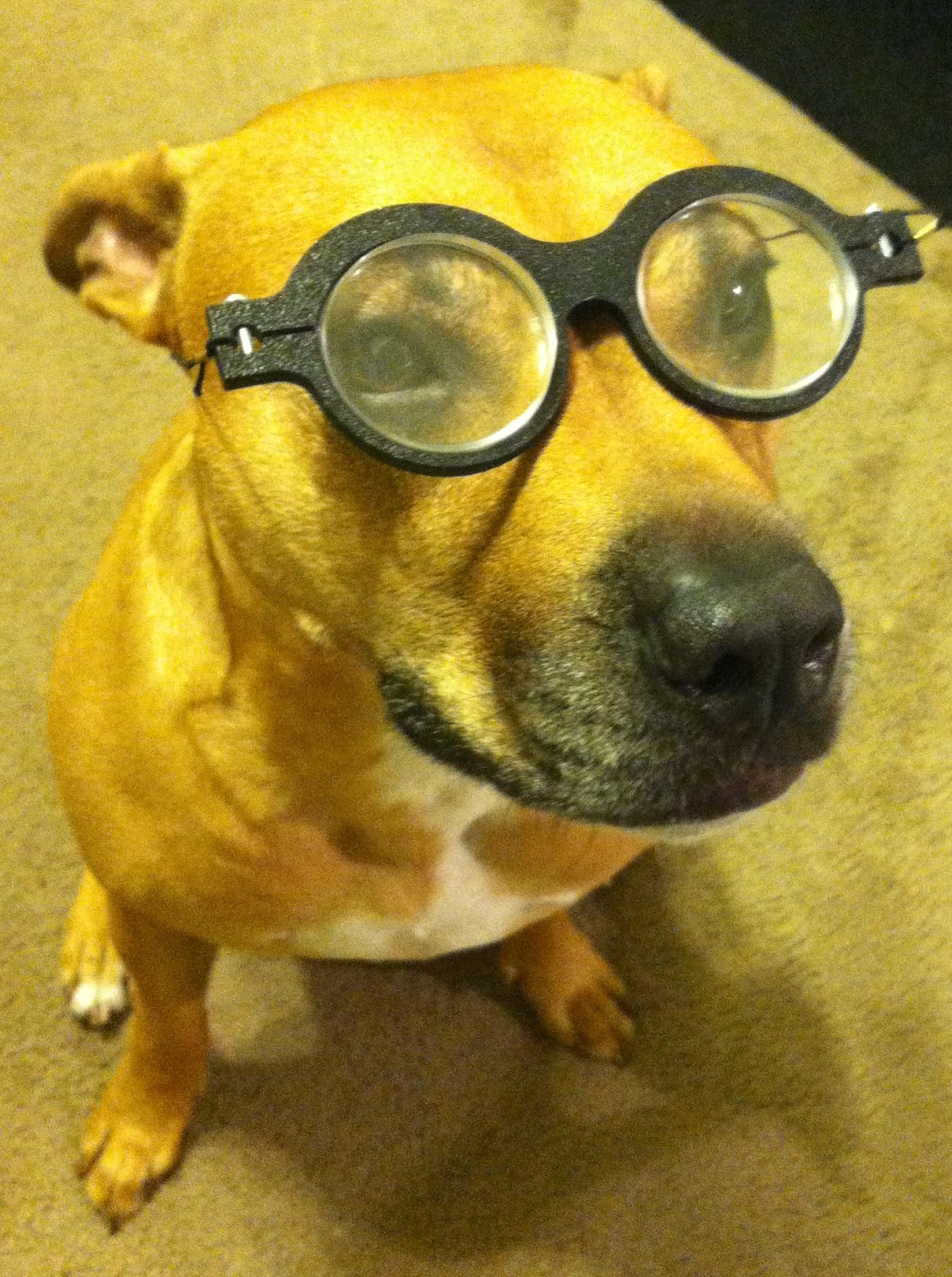
Meet Duke, an American Pit Bull Terrier. He is going to help us model each treatment lens we use here at Nashville Vision Therapy. Thanks, Duke!

To start us off, Duke is demonstrating his focusing abilities and anticipating a tracking exercises. He gets a little bored of just focusing and following a eyeball, so he decided to show us some fancy treatment tools our office uses during Vision Therapy.


Here we go...


Why is Duke wearing 4 lenses? Great question! These are called accommodative flippers. These lenses are used to improve the flexibility and strength of a patient’s focusing system. We use these with the Hart (letter) Chart, when reading, and when we use a tool called Aperture Rule. There are minus lenses on one side, and plus lenses on the other. The word "flipper" comes in handy because you flip the lenses back and forth while doing certain exercises to improve the focusing system.


Harry Potter is that you? No, it's just Duke wearing prisms! I could go on and on about prisms. We use them all the time, kids think they are so fun!  

"Prisms create total "eye-mind-body” changes and improved perception of depth and space.  Prism produces changes in orientation with corresponding shifts in both eye movement and pelvic positions. They are a valuable tool in breaking down patterns that have developed over time that enable the patient to cope with their visual condition." 

Here is a great article about prisms, which includes examples on how to use prisms in Vision Therapy exercises. Take a look: http://www.oepf.org/sites/default/files/22-5-FOX.pdf.


Duke circa 1970. These red/green (or can use red/blue lenses) lenses help us use both eyes together. Using these red/green lenses, allows us to see if a patient is suppressing the visual input from one eye.

When using these lenses we use a transparent film with red/ green stripes. We place this film over reading materials, hidden pictures, mazes, or letter charts. When doing the exercises you have to use both eyes enable to see the whole image. If you are not using both eyes, parts of the picture will be missing.


Each one of these tools helps the visual system work more efficiently. What do you think? Which lens have you used during therapy, and with what exercises? Have questions? Email us at VT@rdeyes.com.


Friday, July 19, 2013

Work that Peripheral Vision

Hello, readers. Happy Friday! If you remember, last week we talked about peripheral stability. As promised, here are some fun peripheral awareness exercises for home!
 
A couple of weeks ago I discussed building up the vestibular system. One of the exercises I mentioned was reading a letter chart while tossing a beanbag from your right to left hand and back again. This exercise is also great for your peripheral vision! Because you’re reading the letter chart, your central vision will be fixed straight ahead. This means that you will have to rely on your peripheral vision to get the beanbag back and forth. You can also use scarves (or a balloon) in place of beanbags to start, since the beanbags fall faster and will be more difficult.

Thanks to a fellow vision therapist, I have been doing a lot peripheral taps lately! They are a great easy home exercise. They note:

"Peripheral Taps
1.      Place your finger tips near your body facing the student
2.      Without taking their eyes off of you (I put a stick on my nose for children to focus on), have the student tap your fingers with his/her finger tips.
3.      Alternate hands and places around the face.”

Another awesome activity (that works on tracking AND peripheral vision) that I found is described in the following video. This activity would be easy to create at home, and is fun and engaging! Using regular flashlight is just fine.


As Dr. Julie mentioned when children or adults block out peripheral vision which then creates a tunnel vision effect it can cause loss of concentration and/or difficulty driving.

These are fun, easy home exercises to do at home that will greatly improve your peripheral vision. Try them out and let us know how it goes!

Thursday, July 11, 2013

Peripheral Stability

Since Autism Awareness month was in April, I have been doing more research on how vision is affected by the diagnosis. As you might remember in this blog,"The goals of treatment may be to help the autistic patient organize visual space and gain peripheral stability so that he or she can better attend to and appreciate central vision and gain more efficient eye coordination and visual information processing."

The main phrase that stood out to me was "peripheral stability." I emailed some fellow Vision Therapist on ways I can incorporate more fun peripheral vision exercises into our treatment.  From there I looked for articles about peripheral vision and found an article by Dr. Gallop, titled "The Peripheral Visual Awareness: The Central Issue". The article had so much great information that I thought I would share a few tidbits that helped me a lot.

"Peripheral vision is the lion’s share of vision and, is also a big part of life. It is involved with detecting and understanding the big picture – the context and changes in our environment. At least visually speaking, it helps to keep us in touch with our relationship to everything with which we share visual space. Peripheral vision is at the heart of awareness of, and response to, the total space volume of our visual environment and all its inhabitants. Without the involvement and guidance of peripheral awareness the fovea would, for the most part, be “lost in space,” not knowing where to turn."

"This may also contribute to attention problems because without sufficient peripheral awareness, the context of visual space is lost and it becomes difficult to distinguish figure from ground. The environment becomes a series of unconnected, unrelated details to be dealt with one at a time – the background is practically non-existent."

"It is important to note that the real importance of peripheral awareness is not in the receiving of information as much as is it is in the response to that information. Knowing what is in our surroundings is important in the context of action for survival. While it is certainly important to know what is going on out there, it is equally important to know what needs to be done and how to go about doing it in response to what is going on out there. Peripheral vision provides an early warning system and is what guides our movements in response."

"Peripheral vision supplies us with information about our relationship to our surroundings. It tells us where we are in relation to people, places and things in our immediate vicinity. It can provide significant information about who they are, what they are doing, and how that may affect us at that moment and in the near future. When functioning comfortably and effectively it can provide accurate information regarding size, shape, direction of movement, and even intent."

"Just as improvements achieved through vision training often transfer into improvements in areas such as problem solving, concentration and self-esteem, improvements in peripheral processing may transfer into more so-called peripheral aspects of our lives."

Our peripheral vision is not something to mess around with. It is an important for our survival! Loved this article! Next week I will gather up some great peripheral vision awareness exercises that you can do at home. 
Monday, July 1, 2013

CNN article

One of my favorite news apps on my phone is the CNN app. I like the quick videos, and articles of the current events happening around the world. I will say, the "Distraction" videos on CNN are always a favorite. Like this one:


While reading some articles, I stumbled upon this: Man: 3-D movie changed my sight for the better. It is about a man who "had poor depth perception. His eyes pointed outward and did not allow him to see, in stereo, a single image with both eyes." One day he went to see Hugo in 3-D and "to his amazement, the characters and scenery in this film jumped out at him in greater stereo vision than he had experienced before." And even after the movie ended, "perception of the real world was enhanced as well. A lamppost jumped out from the background, and the trees, cars and people looked somehow more vivid."

Did the 3-D movie cure his poor depth perception and make his eyes point in the same direction? Read the rest of the article to see what happens! Stereo Sue makes an appearance in the article too!

It was a very interesting article, that I was so excited to read! Has anyone else found any great articles, that you were excited to see that related to Vision Therapy? Pass it along!

Have a happy 4th of July! 

Tuesday, June 18, 2013

Workin' the Vestibular System

Today's blog is about balance. As you might expect, our visual system play a big role. And when we work our visual systems, our balance/coordination gets better. For more information on that, check out this blog, and this blog.

How can we speed up the process (per se) and incorporate balance either in everyday things or with our Vision Therapy exercises? Lucky you, I am going to give you some fun ideas:

  • Put a letter (or shape, picture, number, arrow) chart at eye level and walk heel toe, heel toe forward, and then backward. Basically, walk a straight line while reading a letter chart.


  • Walk a straight line while tossing a bean bag (or ball or scarf) from right to left hand.  Take it to the next level and add a letter chart while doing all that!  
  • Reading a letter (or shape, picture, number, arrow) chart while bouncing (not too high) on a mini-trampoline.
  • While jumping on a mini-trampoline catch bean bags, and different sizes/types of balls. 

  • Jump on the mini-trampoline to a beat. Metronomes work great! Crank it up a notch and add a letter chart. Read letters and jump to the beat. Whoa!
  • When reading or doing homework, sit on an exercise ball. You will find, that (No. 1) it is very comfortable, (No. 2) helps your attention and (No. 3) works that vestibular system.
  • Go to the play ground and use the balance beams. 
  • Stand on one foot and read the letter chart. Alternate feet between every 5-10 lines. 
  • Balance boards are a great tool: catch bean bags, catch/bounce balls, read the letter chart while balancing!
  • Balance boards with an arrow chart: shift your weight on the balance board  in the direction the arrow tells you. Just like the video above! 
 
How is that for fun, fun, fun!!! Give these a try and crank up that home therapy. Make it interactive, and be creative. Have any questions? Email me: VT@rdeyes.com


Tuesday, June 11, 2013

Skydiving

My fellow teammate has helped me get more organized with my blogs. When looking at the blog scheduled for this week, the subject is "Personal Connection Blog." I wanted to blog about something fun or exciting that I have done and relate it to what I do... Vision Therapy!

Over Memorial Day weekend, I headed south to Mississippi to visit my niece and then couple days later I met up with my in-laws. Don't worry it gets more exciting. I went skydiving. Yes, you heard right, I jumped out of a perfectly functioning airplane.

But don't worry, I did it for a good cause - I jumped out of an airplane to support and to celebrate my mother in-law's 60th birthday. Not only that, I helped her cross out an item off her bucket list. After we safely landed and we calmed our nerves, we talked about the jump. She mentioned that months leading up to the jump, all she visualized (great VT word!) floating in the air and seeing what the birds saw. What she didn't visualize was the process of jumping out of an airplane. As much as my mother-law enjoyed it, she said she would never do it again (case in point with picture down below).

You are probably thinking, how is this going to relate to Vision Therapy? Here's a good quote I found (bold text is my emphasis):


-Any process of personal growth and healing requires us periodically to let go of what we have or of what we know and sit with the anxiety that comes with being in uncharted territory. We come to points where we recognize that what we are doing or clinging to no longer serves us. 

We must let go of what we have that no longer works for us in order to make room for the better and healthier. We can’t wait until the newer and better are here to let go of the old—we must let go and hang out in the space in-between.

It’s like jumping out of an airplane and being in free fall, waiting for the parachute to open. With time and experience, it becomes not so much terrifying as it is exhilarating, and we let go more readily of the old and are more comfortable in the space between, as we wait to discover what comes next.-

When embarking into our Vision Therapy program (uncharted territory), the experience can be terrifying (especially for a child). You have to let go of your normal to-do's and open up room for new to-do's (like home therapy and weekly visits). But with time and experience in the program, you begin to discover a whole new world.